by Helen | Sep 28, 2022 | Lifestyle

For such a long time, I’ve been trying to find glasses like the one on the right of the photo, above. We seem to smash our “every day” wine glasses on a regular basis in our house and never seem to have an even number, so the quest was on to find something that was a bit more robust than the basic IKEA glasses. Something with a bit of a sparkle. A bit of cut glass. Preferably in a smokey grey colour. And something which looked a lot more expensive and classy than they actually were. Online searches proved a bit fruitless, because even when I found them, the cost of having them sent out to us, was silly money. We do have lots of shops here that I thought would sell them, but nothing was ever quite right.
Until I visited Tedi. Now, I don’t think Tedi operates in the UK, but it’s a great shop. It’s the kind of shop that is full of tat – think Hallowe’en accessories piled high in the summer – but, it’s also my go-to place now for very unusual candles, garden accessories, often plates and dishes, faux plants. The kind of stuff that I like, is usually left unsold as it clearly doesn’t appeal to Tedi customers, so for me, it’s a bit of an Aladdin’s Cave. And, over the summer, guess what I found in Tedi? That’s right! My smokey grey wine glasses…

I am sure mine are exactly the same as the one photographed above, but at just €2 each, I am guessing a whole less expensive. They are chunky and comfortable to hold. Unlike those IKEA cheapo ones, which always feel as if they are going to smash your hands. And, sometimes have. The bevelled glass is lovely, and the attention to detail is very intricate.

They do look delicate and very pretty, but are sturdy and substantial and the four that I bought have withstood a summer of wine drinking.
So, there you go. Tedi – one to look out for if they ever open in the UK.


by Helen | Sep 28, 2022 | Croatia, Travel
Zadar has the most beautiful sunset in the world, more beautiful than the one in Key West in Florida, applauded at every evening.
So said, Alfred Hitchcock, on a visit to the stunning Dalmatian coastal city of Zadar. And, if he said it, it must be true…

We are now very, very lucky that we can reach Zadar quite easily. Living in Istria, it’s a beautiful drive down the Adriatic Highway – or, the Jadranska Magistrala – the 650 km long road which runs just a few meters parallel to the Adriatic sea, Running from Rijeka on the Kvarner Gulf to Karasovići on the border with Montenegro, this road is one of Europe’s most unforgettable journeys. As it it weaves its way around deeply indented turquoise bays or skirting scree-covered mountains, there’s scarcely a single boring stretch along its length. Especially when you are driving alongside the northern islands of Krk, Rab and Pag, rising like sleeping elephants out of the sparkling sea. This summer, family flew into Zadar from the UK and so we took the opportunity to spend a couple of days here, to introduce them to one of our favourite Croatian cities.
The name Zadar, means gift of the sea, and located where it is, on a peninsula surrounded by the Adriatic, it’s name makes perfect sense. As well as being beautiful, it is ancient and full of history, as explained by Boutique Hostel Forum :
The heart of Zadar, a location where it all began, is a street known as Kalelarga (Široka ulica). The people of Zadar will tell you it’s older than the city itself. Even though Zadar was mentioned already in the 4th century B.C.E. as the settlement of the Liburnians, it was the Romans who started forming the city two thousand years ago on the peninsula with Kalelarga as one of the main streets. The city was built like a typical Roman city with all its amenities. As the Roman Empire started falling apart, so did Zadar deteriorate in particular during the Migration Period, with low point in the 5th and 6th century. From the 6th to 11th century Zadar was a part of the Byzantine Empire. It became the administrative centre of Dalmatia and Venice’s equal on the Adriatic sea. And Venice sure didn’t like that becoming one of the most fierce opponents of Zadar and trying to overpower it for centuries to come. In the 11th century Zadar formed part of the Croatian lands for the first time, with Croatians becoming the majority population. The period between the 11th and 14th century, when the first Croatian university was founded in Zadar, is considered Zadar’s Golden Age. Despite constant threats and occasional pillages, Zadar flourished in every aspect during that period.
The Venetians finally managed to get hold of Zadar in the 15th century and it remained under their rule until the end of the 18th century. Zadar’s economic role was diminished and the city had to face two additional threats: the plague and the Ottomans (Turks). After a brief French rule beginning of the 19th century, Zadar became a part of Austrian (-Hungarian) Monarchy turning into a splendid, vibrant Dalmatian city yet again. Another round of ups and downs was in store for Zadar in the 20th century, with Austrian-Hungarian, Italian, Yugoslav and finally Croatian rule superseding one another. Heavy bombardments during the WWII destroyed more than half of the historical centre. The second half of the 20th century saw tourism-related rise which was again interrupted by a series of attacks during the Croatian War of Independence.
The historical centre of Zadar is small. Concentrated on a tiny peninsula, it can be walked around in a couple of hours. Of course, proper exploration will take a whole lot longer because of the labyrinth of marbled streets, opening out onto squares and parks and the coastal esplanade (The Riva), which is currently being redeveloped in places, ensuring that wide pathways make walking and cycling a much more pleasurable experience. The centre is a traffic free zone, but there are large, and accessible outdoor car parks, around the city. We spent two days there recently, and car parking was easy and inexpensive. There’s much to recommend in and around Zadar, but highlights have to be The Sea Organ and the Salutation to the Sun, both designed by renowned Croatian architect, Nikola Basic.

Both a piece of art and an experimental musical instrument, The Sea Organ creates beautiful chimes, using only the rolling power of sea waves. The installation looks like a series of broad steps leading down into the sea, hiding clever engineering beneath their surface, producing ever changing syncopated sounds. Close by, The Salutation to the Sun represents the solar system, with the sun and the planets in their proportionate sizes, featuring a series of circles made from photovoltaic glass panels set into the pavement. The panels gather energy from the sun throughout the day, and come evening, lighting elements beneath the glass create a mesmerizing display that simulates the solar system. The solar energy collected by Sun Salutation also helps power the entire waterfront.


Photo credit : bestofcroatia.eu
Zadar is a city of significant historical influences, including reminders of Venetian rule, but perhaps more obviously, Roman rule. From The Riva, you can walk a short distance and be in the centre of The Forum – no roping off, no entrance fee, no restrictions. Just ancient reminders of a past, right in front of your eyes. We’ve visited Rome and Naples and Athens and other historical sites, but there’s something that’s very special about this part of Zadar. Maybe because when we first visited, we didn’t really know anything about Croatia, lets alone its history, but now we live in the middle of it and it feels so real. Not just a holiday experience, any more…

Zadar is located on the Dalmatian coast of Croatia, north of Split and Dubrovnik, making it accessible by road (if you are on a Croatian roadtrip) or by air, having its own international airport. As well as the historical sites and architectural structures, the city is full of fabulous restaurants, cool bars, boutique accommodation – and of course, the turquoise Adriatic which wraps itself around the peninsula. A much recommended Croatian destination.

by Helen | Sep 19, 2022 | Italy, Travel
Cagliari is a city like no other Italian city we have visited. It’s a port city, and it wears its history on its sleeve. Everywhere you go you come across traces of its rich past, from ancient Roman ruins, to museums filled with prehistoric artefacts, to centuries-old churches and and elegant palazzi. It is located on the Bay of the Angels (Golfo degli Angeli) and, like Rome, it was built on seven hills, which identify the historic neighbourhoods of the city. The port area is busy, busy, busy – the main road runs along the sea front and cars and buses and vespas and motorbikes whizz past, so you need to be on your toes. Once on the city side though, it reveals itself as a beautifully elegant place, with imposing, honey coloured buildings, with elaborate balconies and shuttered windows, facing the sea. Wide tree-lined boulevards are packed with cafes and bars, and people catching up, eating, drinking and generally making life look pretty wonderful!
We stayed in an apartment, up the hill from the sea, but still “downtown”, on the beautiful Piazza Yenne. The piazza is bordered by bars and restaurants at ground level, and is lively. But, look up, and you see those beautiful buildings with balconies and railings and shutters. Our apartment was on the top floor of one of these buildings and have been exquisitely renovated – with sound-proofing, too, so we could shut out the noise when we wanted to. Piazza Yenne is the main meeting point for locals, especially during the hot summer nights. People gather here to have a chat before moving on; to sit in the terraces of the many cafes and bars, or simply, to passeggiata. Over the course of two visits to Cagliari we were there for four days in total, and so managed to get out and about and explore quite a lot of the whole city. It’s magical. It’s beautiful. It’s raw and feels real, the kind of city you could actually imagine living in.


You can either climb up to the upper town, or take a glass street elevator (at the top of Piazza Yenne) – whichever you prefer, just do it, because the upper part of town is even more beautiful and the views even more spectacular. It’s also not quite a crowded and busy, so you can feel a little more as if you have bits of the city to yourself, even in the height of summer.


by Helen | Sep 14, 2022 | Lifestyle
I say this is an Italian Potato and Ham Pie, because I found the recipe on an Italian website – and I used mozzarella and parmesan cheese – but apart from that, I don’t think there’s anything specifically Italian about it. What it is about, is a recipe that is so easy, and ultimately so delicious, that you just have to try it.
what you’ll need
- Potatoes
- Two egg yolks
- Cheese – the original recipe calls for caciocavallo cheese, but I couldn’t get this and so substituted it with mozzarella
- Grana Padana cheese (or parmesan)
- Fresh Spinach
- Sliced ham
- Olive oil
- Garlic
- Salt & pepper
- Rosemary – fresh is best, but dried will work, too

what you’ll need to do
- Boil the potatoes until ready for mashing – drain, season with salt and pepper, add the grana padana (amount according to taste) and mash, the add the egg yolks, salt & pepper and rosemary and combine, then use of the mixture to line a dish or oven proof tin
- Saute the spinach in the olive oil and garlic – when wilted, drain, so that all of the excess water is removed
- Put a layer of the garlicky spinach over the potato, then a layer of the cheese you are using, then a layer of sliced ham
- Add another layer of cheese and top with the remainder of the potato, pressing it down, so that it is compact
- Brush a little oil over the surface, and bake for around 50 minutes in an oven, pre-heated to 190°C – it’ll then be ready to eat immediately or saved for later, and eaten cold

Photo credit : www.giallozafferano.com

by Helen | Sep 5, 2022 | Lifestyle

Making a soup is definitely not difficult, especially a veggie one. I’ve made variations on this recipe before, usually making it up as I go along – because how difficult can a soup made of courgettes and tomatoes be? But I decided this time, I wanted something a little bit different, as all of the veggies had come from our garden. Grown from seed. So, this time, I wanted a soup to remember. And, boy, did I find one! It’s still super easy to make, but it packs a punch in flavour terms, as it also includes spicy paprika and a generous sprinkling of chilli flakes. As autumn approaches, and as your garden may have a glut of zucchini and tomatoes, this is definitely a recipe I’d add to your warming and wholesome collection…

what you’ll need
- Tomatoes – ideally ripe tomatoes on the vine for the best flavour. I used a mix of larger beef tomatoes and smaller cherry tomatoes from the garden.
- Courgettes – for this recipe I used one courgette – the one above – and it was definitely sufficient
- Olive Oil – a nice big splash, to start cooking the courgettes
- Large White Onion – red would work as well, I think, but I wanted a bit more depth of flavour
- Plain Flour – a large, heaped tablespoon was used to thicken the soup
- Veggie Stock – two cubes were more than enough, in about a litre of water, which I topped up as & when necessary, as the soup was cooking
- Fresh Basil Leaves, chopped – dried basil would also work, but fresh was delicious
- Spicy Paprika and/or Chilli Flakes – depends on how much of a kick of you want your soup to have. We like spice, so used both.
- Tomato puree – a generous squeeze, for extra colour and richness of flavour
- Salt & Pepper – according to your taste

what you’ll need to do
It really is a chuck-it-all-in-the-pot and let it do itself recipe. I heated the chopped onion and courgettes in the olive oil for about 10 minutes, sprinkling with plenty of salt and pepper. Once soft, I added the paprika and chilli flakes, then the chopped tomatoes and mixed in the plain flour, cooking for a further 10 minutes. The stock was added along with the basil leaves – leaving a few unchopped for garnish – and the tomato puree and simmered for about 40 minutes. The soup was whizzed up until smooth, given another 10 minutes on the hob, and then served with warm, crusty, granary bread. And, there ware more than enough for lunch next day…


by Helen | Aug 16, 2022 | Croatia, Travel
Every now and again, you stumble upon the most perfect place to stay. It happened to us last year when we discovered The Dolphin Suites, on the beautiful island of Veli Lošinj. And it’s happened to us again this year, having discovered the most wonderful little boutique B&B, in a renovated villa, high up in the hills above Crikvenica on the Adriatic coast of Croatia.

We finally had family out to visit us for three weeks – the first time since 2019 – and when we took them back down south to Zadar to fly home, we decided to do a stop over, to break up the journey home. However, my chosen hotel – the Almayer Art & Heritage Hotel – in the historical centre of Zadar, was fully booked, so the search was on to find something as unusual and special. And this was when we stumbled upon Boutique B&B Mali Pariz (“Little Paris”).
Coming off the coast road – The Adriatic Highway – we wound our way up into quite hilly territory. Renovated villas nestled next to very contemporary new builds, all with spectacular views across the bay to the northern Croatian islands. Tiny villages emerged around hairpin bends, with the obligatory abandoned houses and churches, being reclaimed by nature. We climbed higher and higher, not sure what we were going to find at our destination – but we need not have been concerned, It was just gorgeous.

A very elegant, pale pink early nineteenth century, with shuttered windows and a huge double wooden front door revealed itself as Mali Pariz, with the the hand-painted signage on the side of the building. Through the grey iron gates, the prettiest courtyard was revealed. Pea-gravels paths, lots of plants in terracotta and zinc containers, established fruit trees and creepers, growing across the walls. Hanging baskets and pots on window sills. A raised area with different sized tables and chairs. Candle holders. Hurricane lamps. Strings of lights in the trees. And, a tantalising glimpse of a upper level, with sun umbrellas and loungers – and hidden from view, so completely private, a swimming pool.
There are only seven rooms available in this boutique hotel – two family suites on the ground floor, two doubles on the first floor and two doubles in the eaves of the house, as well as a stand alone annexe in the garden. Our room was a deluxe double in the attic, up two flights of wooden stairs and through very pretty landing areas, with lots of French style furnishings.


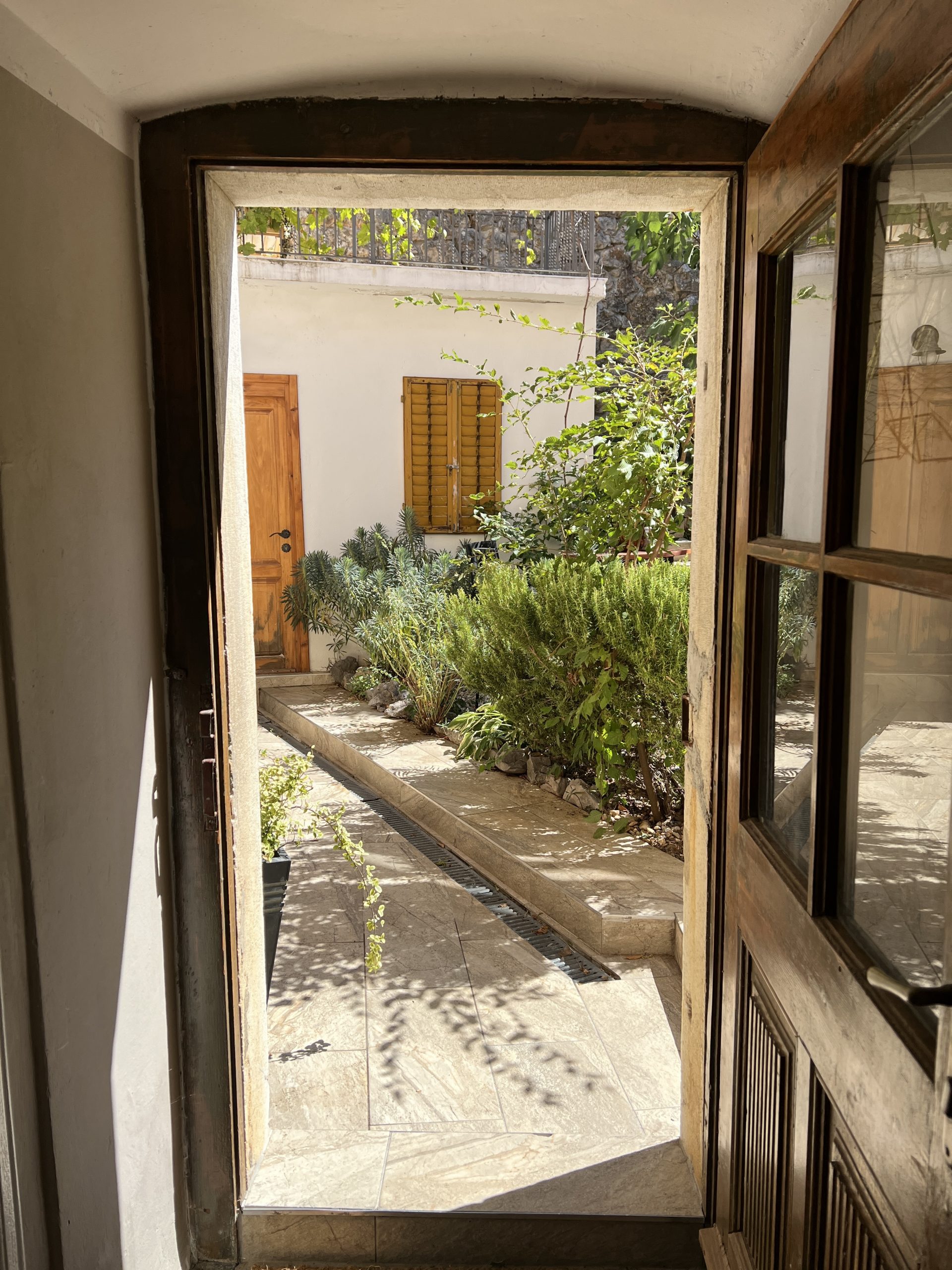
Being right at the top of the house, the ceiling could be an issue as it sloped down, almost to ground level on both sides. It’s probably best to remember, at all times, that there are low beams, both above the seating area and the bed. As cute as our room was, the jewel in the crown of this little hotel, is definitely the outside space. Hidden behind the big gates, it’s completely private and as pretty as picture.

Breakfast is included in the room rate, but for an additional (very reasonable) charge, Martina, the owner, will prepare an evening meal, which we were very grateful for, not arriving until 7.30pm. The nearest large town, Crikvenica, is a drive away and we didn’t fancy heading out again, especially as the garden looked so alluring as dusk set in. I think because we hadn’t pre-ordered, we largely had to take what was on offer and we were offered pasta, which was fine with us. However, we definitely didn’t expect such a simple dish – spaghetti with tomato, garlic and basil – and a rocket salad, smothered in nutty olive oil, to be quite so delicious. This is our staple kind of week night dinner, but whatever Martina did with it, it was super gorgeous. Maybe it was a combination of the setting and her excellent white wine…

Self service breakfast was simple, but substantial – meats, cheeses, bread, juices, coffee – and eggs. We opted for an omelette, which was prefect – light and fluffy but browned, just right. And again, sitting under a fig tree, and surrounded by oleanders, as the hot sun shine down on the terrace, was lovely. However, the best thing was the relaxed approach to the morning. Although check out is stated as 11am, I got the distinct impression that if you were a little later, there would be no problem. And with breakfast being served until 11am, it all felt very laid back. we had the most amazing weather – in fact, the whole summer in Croatia, has been amazing – but this little boutique B&B is also well set up if the weather is a little more inclement, with a very pretty glass walled internal dining room.


If you are looking to stay somewhere that is right in the centre of the action, with bars and restaurants on the doorstep, we definitely wouldn’t recommend you book a night or two here. But, if like us, you’re looking for peace, quiet, relaxation and somewhere that is beautifully quirky, we definitely would recommend Mali Pariz. A little bit of French chic, up the hills, on the Adriatic coast.

by Helen | May 24, 2022 | Lifestyle
Not too far from our house, but a little off the beaten track, along a country road, through beautiful scenery, to the end of the village of Medici, is the last of the closest restaurants to us, which we’re ashamed to say we only investigated recently. We’ve always known about Medica, as it is signposted form the road, and we’ve read fantastic reviews, but we always found a reason to go somewhere else. So, on a very hot, sunny, May weekend afternoon, we decided to put this right and make a visit.

You wouldn’t get here without transport, and as there is no public transport in these parts to speak of, you would need a car. Or a friendly driver who didn’t mind taking a hit on the vino. It’s pretty isolated, being right at the end of the track, but with views like these, across the Mirna Valley, who cares? Motovun can be seen, on top of the hill, on the right of the photo, and just out of view, Oprtalj. Breath-taking.
The car par was full when we arrived and there was only one table available outside on the terrace, so we were lucky we arrived when we did. I think all of the cars, apart from ours, had Italian licence registration plates. Conversations all around us were conducted in Italian and the owners spoke only in Italian. Unsurprising that our part of Istria is often compared to Tuscany or Umbria.
The set-up is as simple as can be. On ordering our drinks, we were given a choice – vino rosso or vino bianco. No wine list. But we knew that the wine would be good – restaurants around here, which produce their own wine, have to make sure its good, otherwise people will just go elsewhere. After all, we’re not short of options. Mezzo litro di vino bianco ordered and we were onto the food. Again, a very limited menu, but this time there was a menu…

No fuss. No frills. A sheet of A4 inside a plastic wallet – very handy as menus will change according what is available, although I would be urging that they lose the caps lock! Because we were eating later in the evening, and had only really come to check it out, we opted for sharing portions, rather than main meals.
Homemade bread – warm and fresh – was the perfect accompaniment to a plate of Istrian cheese, which had a parmesan texture and taste, and olives. The fritata con tartufo was perfect – clearly made with the freshest of eggs, and resembling more scrambled eggs than a traditional omelette style fritata – and laced through with truffle cream and topped with truffle shavings. A portion of patate in tecia was ordered as we are on a mission to try this dish whenever it appears on the menu, as it’s gorgeous. It’s a mashed potato dish, cooked in a tecia, a flat cast iron pan, sometimes like hash browns, or sometimes, like the one served in Medica, like bubble & squeak, with it’s browned top and bottom. I think we can safely that probably everything we ate and drank came from with 50 metres of our table, as the agroturizam is also a small holding, with olive groves, sheep, goats, hens, rabbits, cattle and a couple of pot-bellied pigs, as well as donkeys and ponies and a variety of birds. Which I think were to add to the small zoo feeling, rather than menu items. Although I couldn’t say for absolute certainty…

So, another really delightful restaurant, not too far at all from our house. Although it’s not fine dining by any stretch of the imagination it’s really good, wholesome, homegrown food, definitely served with love by the owners.

by Helen | Mar 31, 2022 | Lifestyle

2022 is going to be Grow Our Own year. We’ve tinkered around the edges of growing vegetables and herbs before, but it’s always been pretty half-hearted as far too much else has been going on in and around the garden. We’ve had minor success with lettuce and tomatoes and back in Didsbury, we did successfully grow strawberries and potatoes. But this year, the house renovation has finished and we’re focusing on the garden, so being a bit more self-sufficient is the aim.
Along the side of our house and garden, is a long strip of communal land. This was originally the road into the village, but it isn’t any longer. The road is on the other side of house, so this strip of land – owned by the local council and a number of individuals – is largely unused. Somewhere, presumably on hiking maps, it may still be marked as a right of way, because on a couple of occasions, we’ve had people with hiking sticks appearing. And being as startled as us! Maybe once a year, one of our neighbours will bring his tractor along the grassed lane to get to his field, but we can probably can count on one hand, how many times it’s been used by anyone other than us. So, we’ve been working hard to make it good, and frame the house. We have a hammock, in the summer, strung up between two of the trees and patches of wildflower seeds have been sown. This year, we’ve added pots of bulbs and a cluster of potted bamboos. But, it’s the veg we’re working on, more than anything.
If there’s one thing we have an excess of around the house, it’s Istrian stones, so these are being to use and we’ve made a vegetable patch, which sits in front of a small wall, and is in full sunlight. As we also have an excess of logs, we’ve divided the patch up with these and labelled each section. So far, we have sown peas, courgettes, cucumbers, rocket, lambs’ lettuce, carrots and onions – and already, just a week after sowing, the green rocket is pushing up through the soil. The bed was dug down and raked over, before the stone frame was built around it. To save on good soil, we back-filled the whole thing with twigs and branches, then mulch, then our own rich, red soil before adding a layer of top soil. A water butt, which was useless for collecting rainwater as the tap had snapped off, and couldn’t be replaced, was cut in half, and this has made an excellent planter for potatoes.

We have two apples trees and a cherry tree which were planted early last year, but didn’t produce anything very much last year – we did celebrate the one apple! – but already this year, they are heavily budding so we have high hopes for them. Once the much needed rain passes, we’re going to be planting up tomatoes and strawberries, too. It’s fair to say, we are crossing our fingers for a bumper harvest across the board this year.


by Helen | Mar 31, 2022 | Lifestyle
Like everyone else in lock-down, we tried our hands at bread-making. Not the arduous kind of bread where you have to proove it for days. More the kind that you knock up in a bread maker. We did have success although we did still find even using the machine to be a faff, and so never really got away from the supermarket purchases. Until now…

I think it might have been on an Instagram feed that a recipe came up from Siggi’s, using their Icelandic inspired yogurt which does not contain artificial preservatives, thickeners, sweeteners, flavours or colours. I love this yoghurt and so was immediately interested. And, with so few ingredients, decided to give it a whirl.
The recipe uses cups as a measurement, as it’s an American website, so a bit of conversion had to be done first. For the record, this accurate:
- 1 cup = 136 grammes
- 1 cup = 237 millilitres
what you’ll need
- 4 cups (544g) of all purpose flour
- 1 teaspoon of baking soda
- 1/2 teaspoon of salt
- 2 cups (473ml) of 0% plain drinkable yoghurt
what you’ll need to do
Honestly, this could not be easier. If you have the four ingredients pre-weighed, it’ll take no longer than 5 minutes before it’s in the oven. Especially if you’re an expert kneader!
So, preheat the oven to 190°C (or 375°F).

Add flour, salt, and baking soda to a mixing bowl and mix together with a fork. Pour in the yoghurt and stir briskly with the fork until the ingredients are combined and it holds together. Turn the dough out onto a lightly floured surface and kneed for 30 seconds. Pat into an 8-inch and 1 1/2 inch thick round on a greased or parchment-lined baking sheet. Use a knife to cut an “x” in the top of the bread.
The recipe says to bake for 45 minutes, but we found the bread to be very pale, so did it for 55 minutes and it was perfect for our taste. Let it cool for 5 minutes before transferring to a wire rack. Wrap in a lightly damp towel and let cool completely. And, that is it!


by Helen | Mar 31, 2022 | Renovation
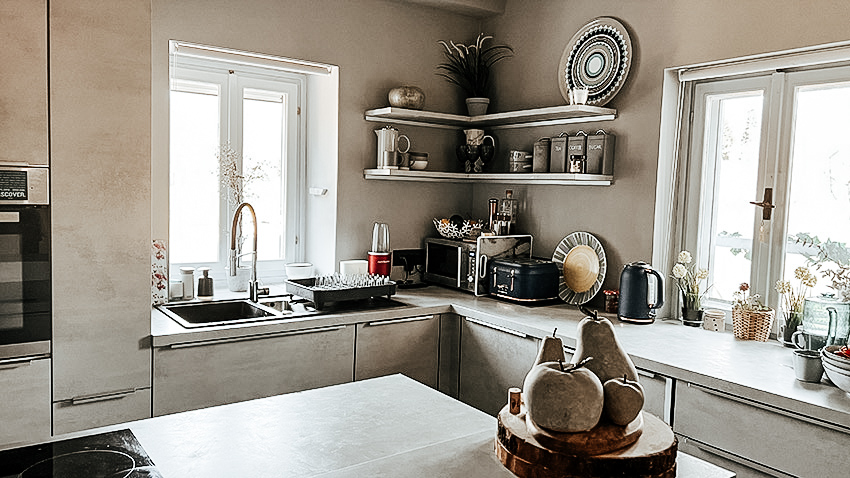
The kitchen was the first room in our Istrian stone house to receive the full renovation treatment. The units we had inherited were ripped out, the flooring taken out, the ceiling taken down, a new window installed, brand new units and appliances fitted and under floor heating put in beneath new flooring. It’s quite a small room, but is a light room and we decided to go bold with the colour. On a trip back to England we brought back 10 litres of Farrow and Ball Hague Blue paint and to the dismay of our builder/decorator – who thought it was the vilest colour he had ever seen – we went ahead and painted all of the walls ceiling.

This colour is a bold one, especially as the kitchen isn’t huge. But, with two windows, and light coming in from the Well Room, we felt it could take this deep shade. For over four years, we’ve loved it, and would happily have left it this colour. But a couple of things made us have a re-think. Firstly, with all of the comings and goings in the kitchen, the walls were due a lick of paint and to get the same one, we’d have had to have gone to the nearest Farrow & Ball showroom, which is in Treviso. Not a bad trip, but a bit out of the way for a tin of paint. We could also have had the colour mixed, which we’ve done before, but we’ve never achieved the exact shade.
We love our greys – various shades of grey appear around the house, because it’s such an easy colour to work with, and so we opted for a soft, smokey grey for the kitchen. Thinking that the coverage would be an issue, we bought three tins of it – completely unnecessary as it was a dream to apply and covered the dark cover really well. In fact, we had so much left over, that we also decided to paint over the dark wall in the Well Room. And, voila! A house very ready for the lighter days of spring and summer…


The newly painted wall in the Well Room, does now look so much better, in its lighter softer colour, making the room seem larger and more spacious. Although we don’t keep the door to the downstairs shower room open, when you do open it, the big, grey concrete tiles seems to sit so much better against the new colour outside…
 It does feel that spring might have finally arrived, after a long winter, and the house now reflects so much more the lighter, brighter days outside…