by Helen | Dec 16, 2020 | Lifestyle
Well, it’s definitely been a funny old year. Since returning from our Christmas road trip, back to the UK, in January, we have been nowhere. Coronavirus quickly put paid to our usual kind of year. No eating out. No mini breaks. No visitors to us, meaning that we’ve not seen family friends since last Christmas – thank goodness for Zoom! Travel restrictions and quarantines are still in place all across Europe and specifically in the countries we’d drive through (there and back) and add in full blown Brexit, and all that that will entail come 1st January, we’re not able to do our road trip this Xmas. However, plans are afoot with family to celebrate Xmas in the summer, and we suspect some festivities may occur with visiting friends, too. So, this all means we are spending our first Christmas, at home, in Istria.
This time of year has always involved much travel for us. Even when we lived in England, travel was still a massive part of the festive season, so it will be quite strange to be in one place. Although we might be able to do a bit of winter sightseeing in Istria, we think we’ll largely be at home, so we are going big on ensuring the house is as Christmas filled as possible. Usually, we don’t do much decorations-wise, as we’re not at home. We do usually have a tree – and when we were in Didsbury we used to have a real tree outside, meaning no needles dropping indoors – but that’s about it. Well, not this year. After a 2020 to forget, we’re going out with a sparkle or two ✨✨
The outside area has played a massive part in our lives this year and we’ve finally (we think) completed the front of the house. Now that it’s all tidy and very pretty (even in winter, for the first time), we wanted to create a bit of a festive feel outside. The kitchen window shutters are rarely closed so we’ve used the bar which keeps them open as a focal point. A long garland of faux ivy has been wrapped around it and around that, we’ve wrapped tiny LED lights. The cherry wood bench underneath still has the birdcages filled with beautifully coloured pumpkins, from back in October. We’ve only had one pumpkin casualty and that was one I sprayed gold which decayed under the film of spray and then collapsed in a pungent mess when picked up… The others – delicious hues of oranges and greens and light blues – are still going strong and look very pretty with lights twisted through the birdcages. The glass-effect summer bauble lights have been brought down from the trees and these also wind their way around the bench.

We’ve once again opted for a real tree outside. This potted Norwegian Spruce will be cared for until we finally move and can plant her up. She does look very lovely on the patio when lit up 🙂

Over the summer. I had a circular willow wreath which was wrapped with lights and hung inside the shed, so that it gave off a soft light in the evening. This wreath has been wintered-up. Again, garlands of faux ivy have been wrapped around it and orange berries inserted into the willow. Hey presto – a Christmas wreath for the front door.

I don’t think we’ve ever had a Christmas wreath before, but this year we’ve actually got two – although the second one came about by mistake. High winds had seen to the solar lanterns in the trees and all that was left of three of them was one of the hoops that formed one of the bases. This was about to be thrown away, along with all of the vines and berries which we’d cut back, when an idea formed…

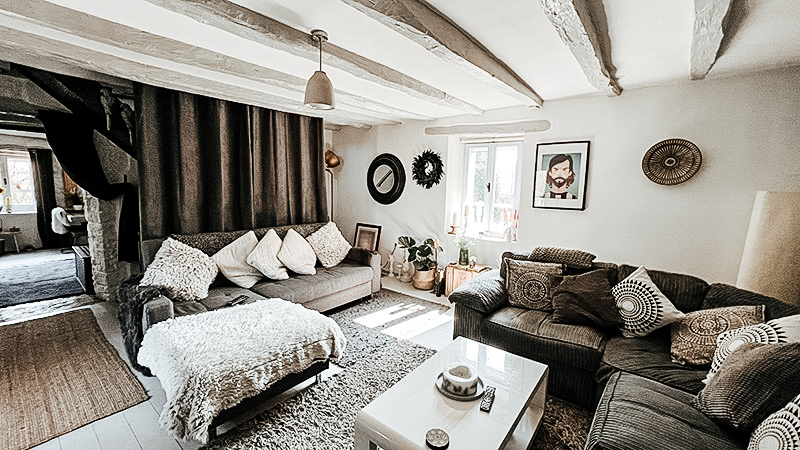
Indoors is where we’ve taken December to a whole new level for us. Because we’ve never been here before over Xmas, it was decided that the house would this year, become a cosy retreat, full of twinkling lights and candlelight and woodburners burning brightly. The dark feature walls in the living room and the well room come into their own in the winter months and so we’ve been beavering away creating our own hygge haven. A fake white tree – another first! – is now sitting prettily in the well room, adorned with black baubles and a black sparkly star. Our big white stars (IKEA old-timers) hang at each of the windows and can be seen when driving down the hill from the village.

Croatia does seem to embrace Christmas as enthusiastically as back at home, and so we’ve had no problems sourcing decorations. Many do seem to be a lot less mass-produced (although supermarkets do the stock ’em up & pile ’em high with glitter baubles) and so we’ve found a lot of very unusual decorations. These wooden carved decorations are all from a store called TEDI – not sure if these are in the UK but is along the lines of The Range. Sadly, as we can’t travel to closer bigger cities such as Trieste or Ljubljana, we can’t get accessories from little independent shops, but hey-ho, we’ve tried our best with the restrictions we’re under.

By accident, I also bought some multi-coloured LED lights, on copper wire. I think the copper misled me, and I thought the tiny bulbs might be white, but no – they are every colour under the rainbow. And, with eight settings, I could have them flashing, flickering, racing. Many ways to bring on a hallucinatory state. Luckily, the last setting is static – and static it is…

In a nod to our new surroundings, we have introduced a bit of a deer theme…


Not sure if we have sparkly gold birds, with yellow feather tails around here, but just in case we do, and we’ve not seen them…


Even a ropey old wine rack which was about to be taken to the tip, got the gold spray pain and LED light treatment. A new life and something salvaged…

I think I’m quite liking getting into the decorative spirit, and even though I have *promised* I’ll buy no more, I can’t really say that I’ll keep this particular promise. It is Christmas 2020, after all! And, our homemade damson gin and blackberry gin is ready. So cheers, saluti and zivjeki…


by Helen | Dec 11, 2020 | Spain, Travel
The absolute beauty of Andalucia. One moment, you can be lying on a beach – this was in November – and the next, up in the snow of the Sierra Nevada mountains. With a trip to the Alhambra, in between.


the alhambra palace and generalife gardens
So, a bit about the history of the Alhambra, from alhambradegranada.org…
The Alhambra was so called because of its reddish walls (in Arabic, («qa’lat al-Hamra’» means Red Castle). It is located on top of the hill al-Sabika, on the left bank of the river Darro, to the west of the city of Granada and in front of the neighbourhoods of the Albaicin and of the Alcazaba.
The Alhambra is located on a strategic point, with a view over the whole city and the meadow (la Vega), and this fact leads to believe that other buildings were already on that site before the Muslims arrived. The complex is surrounded by ramparts and has an irregular shape. It limits with the valley of the river Darro on its northern side, with the valley of al-Sabika on its southern side and with the street Cuesta del Rey Chico on the eastern side. The Cuesta del Rey Chico is also the border between the neighbourhood of the Albaicin and the gardens of the Generalife, located on top of the Hill of the Sun (Cerro del Sol).
The first historical documents known about the Alhambra date from the 9th century and they refer to Sawwar ben Hamdun who, in the year 889, had to seek refuge in the Alcazaba, a fortress, and had to repair it due to the civil fights that were destroying the Caliphate of Cordoba, to which Granada then belonged. This site subsequently started to be extended and populated, although not yet as much as it would be later on, because the Ziri kings established their residence on the hill of the Albaicin.
The castle of the Alhambra was added to the city’s area within the ramparts in the 9th century, which implied that the castle became a military fortress with a view over the whole city. In spite of this, it was not until the arrival of the first king of the Nasrid dynasty, Mohammed ben Al-Hamar (Mohammed I, 1238-1273), in the 13th century, that the royal residence was established in the Alhambra. This event marked the beginning of the Alhambra’s most glorious period.
First of all, the old part of the Alcazaba was reinforced and the Watch Tower (Torre de la Vela) and the Keep (Torre del Homenaje) were built. Water was canalised from the river Darro, warehouses and deposits were built and the palace and the ramparts were started. These two elements were carried on by Mohammed II (1273-1302) and Mohammed III (1302-1309), who apparently also built public baths and the Mosque (Mezquita), on the site of which the current Church of Saint Mary was later built.
Yusuf I (1333-1353) and Mohammed V (1353-1391) are responsible for most of the constructions of the Alhambra that we can still admire today. From the improvements of the Alcazaba and the palaces, to the Patio of the Lions (Patio de los Leones) and its annexed rooms, including the extension of the area within the ramparts, the Justice Gate (Puerta de la Justicia), the extension and decoration of the towers, the building of the Baths (Baños), the Comares Room (Cuarto de Comares) and the Hall of the Boat (Sala de la Barca). Hardly anything remains from what the later Nasrid Kings did.
From the time of the Catholic Monarchs until today we must underline that Charles V ordered the demolition of a part of the complex in order to build the palace which bears his name. We must also remember the construction of the Emperor’s Chambers (habitaciones del Emperador) and the Queen’s Dressing Room (Peinador de la Reina) and that from the 18th century the Alhambra was abandoned. During the French domination part of the fortress was blown up and it was not until the 19th century that the process of repairing, restoring and preserving the complex started and is still maintained nowadays.
Our visit took place in November and we guessed it wouldn’t be quite as packed as in the summer, so chanced tickets when we arrived, and bought General Day Tickets which were approximately €15 each. These gave us access to a lot of the site, including Alcazaba, the Nasrid Palaces, the Generalife and Gardens.You can purchase a separate, less expensive ticket for just the gardens, but as the one we bought included the Gardens, we could also visit the Walk of the Cypresses (Paseo de los Cipreses), Unirrigated Land (Secano) and Saint Francis´Gardens (Jardines de San Francisco.). Your ticket will give you a time of entry and there is queuing system to enter – although obviously in November this was quite short. If you intend to visit in the summer months, come prepared for the heat and a long wait.
Once inside, the site is extensive and can be a bit overwhelming. Even if you’re not a history buff, it’s probably advisable to know a little bit about the Alhambra so that it makes sense. However, it is awe-inspiring and around every turn, your jaw will drop.


These photographs were taken in NOVEMBER. And, right at the end of November, too. A time of year when we’re used to it being grey and overcast – and even if sunny, there’s no colour to speak of. But not in Granada. The gardens are still full of colour and life and vibrancy. The sky, blue and cloudless. Perfect autumn weather. And a perfect time of year to visit this stunning Moorish site, which will make your jaw drop regularly, as you take in its vast splendour and beauty.

by Helen | Dec 7, 2020 | Italy, Travel

Winter is a gorgeous time of year to visit Venice. I’ve only been once in the summer and it was crowded. And hot. Accommodation was much more expensive and I think I just found it all a bit of a faff. So, whenever we go now, we choose to go in the colder months. You definitely can’t guarantee the weather and it’s always best to be prepared for the rain and the cold. And, as we found out in 2019, the Aqua Alta, when we experienced the worst flooding the city had known for many years. But other times, we’ve hit lucky and have had glorious sunshine and crisp weather. We even had the Carnevale when we visited in February and had totally not realised it was happening. Often though, it can be grey and cloudy, but this definitely doesn’t detract from the beauty of this city, and when the clouds break, and the wintery sunshine comes through, well – you just can’t beat Venice…


December is lovely, too, because the city is gearing for up for Christmas, and I can’t think of many places I’d rather be as the huge tree is lit up in St Mark’s Square, and the lights start to twinkle across the city.

We keep returning to Venice because it’s now very accessible from where we live in northern Istria, and because however many times we go, we obviously always discover new areas and new sights to discover. New restaurants and bars, and new hotels and apartments. It’s a city we will keep returning to, and imagining when we are there, that we are residents…

by Helen | Dec 3, 2020 | Renovation
We’ve never had a garden big enough to accommodate our cars. In every house we’ve lived in, parking has always been outside, on the street. Apart from having to usually fight for parking space outside our house in West Didsbury, we’ve never really considered parking. Until now.
When we moved into the house, we had a big elderflower tree and a grassed area. The shovels and spades etc were being used to mark out what we thought might be a pool – that was knocked on the head pretty quickly! Cars used to be parked along the side of the house, but the grassed area there was starting to become worn, so we decided to use the grassed area below. The tree wasn’t very healthy so it was removed and we then had somewhere better to park the cars.

However, over the three and half years we have been here, this area has become more and more messy. Constant driving across it meant that the grass all but disappeared – although hardy weeds survived. With much building work going on in the house, lorries would often park up here, to drop off sand or stone or wood, and so the soil would be constantly getting churned up. And the soil we have here is thick, rich red soil, which, when it’s rained, is like clay. Looks lovely in the fields, not so much when dragged through the house on the soles of your shoes. So, a decision was recently made. The area was going to be sorted, and another project added to the list of jobs we wanted to do to ensure that our home was looking her very best.
Like all jobs we attempt ourselves, we grossly underestimated both how long it would take and how difficult it would be. But, you live and learn.

The first attempt involved the purchasing of a lot of flagstones – these were pretty inexpensive and we figured with a bit of leveling of the soil and plastic sheeting, we’d be good to go.

Of course, first rookie error – we didn’t think it through, because we wanted a hard surface down quickly, before the winter rain arrived – was that as soon the cars were driven onto the flags, some of then cracked immediately. We hadn’t really dug down and embedded them, so we had to have a rethink. Concrete was an option which we considered, but however we did it, it was agreed that the digging had to commence so that we could make the area as level as possible. And again, we didn’t think this through. With a wheelbarrow and a pick axe, we thought it would take a couple of hours or so – but how wrong we were…

We soon discovered where the outbuilding, which had been demolished before we bought the house, had gone. Buried. Under the soil. From slates to huge corner stones, the outbuilding was still there…

We quickly figured that we’d still be digging this time next year and that we needed a bit of advice. Working with our builder it was decided that a digger was needed and that the best solution, once the area was flattened, would be to backfill with a mix of stone and sand, compressed with a proper machine and then a top layer of Istrian stone chippings put down. This sounded like the perfect solution and all was arranged.

A full lorry load of rubble and soil was excavated and taken away, although we did retain some of the more beautiful stones as we had an idea for a wall…

Very early, on a very cold Saturday morning in later November, the first delivery arrived and not long after, with some good rake action, the area was covered, and the cars were driven back and forth to begin the process of compressing the material.

One of the things which has delighted us the most about doing this work, is that the excavation has now properly revealed the curved edges of the patio. Once this is repainted in the spring, it will definitely come into its own.

To finish this part of the job off properly, a machine was used to totally flatten the stones and when done, we had the hard area we’ve been wanting. And no more red soil.

The final piece of the jigsaw was the delivery of the top stones – beautiful milky white Istrian stone chippings.

And, within a couple of hours, it was done. What a transformation, for relatively little cost and done much more quickly than us attempting it with a pick axe and a shovel. The stones we’d saved were used to create a little wall at the front of our property, to finish things off. Heather plants and pink oleanders – which we hope will burst into colour, in the spring – create something more visual and definitely enhance the entrance to the garden now.

We are delighted with the finished result. No more trailing mud into the house and with a specific area for the cars, the garden just seems so much more complete. The next plan will be to maybe construct a pergola over this area, which will be planted up with climbers. But, that may be something for the future…


by Helen | Nov 16, 2020 | Interiors
One of the things that we’ve always meant to tackle, but never got around to it, as there always seem to be other jobs which take priority, is the levelling of a number of our window sills. Some are level, but some, including one in the living room, are still in their Istrian stone state – therefore wonky. They are deep and recessed so perfect for a bit of accessorising, but anything that is placed on them, has a bit of a Leaning Tower of Pisa look about it.

So, after adding a window shelf to the kitchen window, it was decided that this could be a quick fix solution for the living room window. The intention is still to have the window surround and sill plastered, but it depends on how long we are here for. At the moment, we don’t really fancy doing messy work which will ultimately end up with us decorating, so the shelf it is. Another reason for this shelf, is to accommodate the broadband fixed line router. It can be temperamental and likes to be right in the line of vision of the pole in the garden from which the cable comes into the house – and we’ve found the higher up this router is, the less temperamental she is. But resting on the back of the sofa was never go to be a long term solution.
Where we live isn’t built up at all and without our garden lights, the house would look very dark at night time. The garden does look pretty magical when the green wall is up-lit – as you drive down the hill from the main village, it looks like a castle wall. Albeit a very small one. But it is eye-catching and we wanted the windows of the house to be a pretty. (“Top lights” are a thing in Croatia – a bit like Italy – and so we wanted to introduce a bit of lighting ambience…) Hence, another reason for the window shelves, to give us a bit of additional height and to create something a bit more interesting.
The shelves just lift off, so in summer they will be removed, so that windows can be open (they open inwards). But, in winter, there’s no chance of them being open, so we can be a bit over the top in terms of dressing the windows. Come mid-December, they’ll be Christmas-ed up, especially as it’s looking like we’re here for the festive season, but at the moment, we’ve gone for a slightly more subtle approach…

The shelf is just a piece of very inexpensive pine, cut to size and painted white. The router seems very happy in her new elevated position. A string of tiny LED battery operated lights add a bit of twinkle and a shelf not a shelf if it hasn’t got tealight holders for additional flickering lights. I’d love to have the green fingers to keep plants alive and thriving, but I don’t and so all plants are faux. But they never die, which is a result for me! Most of the accessories which currently sit on the shelf are from UK shops or are probably available in the UK :
- Wooden fir tree & pink pillar candle : Søstrene Grene, Stamford Quarter, Altrincham
- LED starlight in glass bottle : The Range
- All plants, aluminium cream pot & gold candlesticks : IKEA
- Green glass tealight holders : Dunelm
- LED string lights : Jysk
We’re definitely not overlooked, so don’t need the privacy that these shelves offer, but when I think back to our West Didsbury house, these would have been perfect, especially at the rear of the house. I think what I love about them most, is that once the brackets are on, the shelf just sits on top and so can be removed as and when necessary. It also means that I can change things around quickly and create different looks and moods without spending anything at all – all I’ve done here is move things from different parts of the house. We decided against putting a shelf up on the opposite window, as it have just felt a bit too much – and the sill on this particular window has been finished so we do have a flat surface. However, I couldn’t resist a kitchen window shelf. And this one is perfect for pots of herbs, as well as a bit of ambient lighting at the front of the house…


by Helen | Oct 30, 2020 | Renovation
If you’re a follower of what we’re up to, you might know that we have a very unusual feature in our front garden. We are right next to an abandoned house and one of its walls forms one of our garden walls. Now, this might sound alarming – and I have to say if we were living back in the UK, the thought of being adjoined to an abandoned house, would fill me with fear. But abandoned houses in Istria are part and parcel of the landscape. These buildings were once family homes – dwellings – and all have fallen into disrepair because families either escaped or were forcibly removed, depending upon the regime they were living under at the time. Many are now being renovated and restored, as descendants lay claim to them or as sympathetic buyers bring life back to them. A lot, though, have multiple owners, often scattered around the world, and Croatian property laws dictate that every single living owner has to consent to the sale, so some are destined to probably never be purchased/renovated. The one next to us, is one such property. It has seventeen owners – we know this for definite as all had to be contacted when we were establishing our boundaries – and some of these owners live in America, some in Australia, a couple in the village and most places in between! So, one thing’s for sure – it’s not going to be sold any time soon.
So, what we do have, is a very, very unique boundary wall, which is covered in ivy and vines. It is an absolute haven for bees and butterflies and birds, and so we have “adopted” the Green Wall. We take responsibility for its upkeep and ensuring that it is kept cut back. The ivy is very heavy and although the strong, thick vines keep it in place, we don’t want to risk it being pulled down with the weight. There are windows (without glass) in this wall, and we always ensure that these are uncovered, because when the sunlight streams through them into our garden, it is beautiful, and we don’t want these to be obscured any more.
But, you do need a head for heights to do the big, once a year, chop back. Or a friend with a head for heights. And we have one of these. And he came to visit with his extendable ladder, a few weeks ago. All of the vines which were beginning to work their way into our roof tiles, were removed and the cracked roof tiles we discovered were replaced, mortared and sealed. This year, we actually had the vines cut well away from our house – there’s now a space of over a metre where there are no vines at all, so we’re hopefully all OK until next summer. The guttering at this side of the house was all cleaned out, too.
Next job was to completely cut back the bulk of the outgrowing ivy – we’re always a bit reluctant to do this, because the bees and butterflies do love it, but we can’t just let it grow wild. Tied onto the very long ladder, our friend chopped it all back – and to get to the highest branches, he unstrapped himself and walked along the top ledge, chopping away as he walked. Health & safety is shall we say, a little less stringent than in the UK…


We left the smaller wall to the right and just trimmed the ivy here, rather than cut it all back at this stage, as we still wanted the berries for the birds, and the late flowers for the bees and butterflies. It’s late October now, but still warm enough during the day for them to all be buzzing around.
So, that’s one of our big autumn jobs ticked off. In the past, when we had our little garden in West Didsbury, winter prep would largely consist of putting pots away and brushing leaves. It’s all a little bit more involved now, but once done, we can rest easy over the winter, knowing there’ll be no water ingress caused by leaves in the gutters or tiles being lifted because of ingrowing vines. It’s always a good day, too, when we know that the weight of the vines has been removed and that we’ll better growth next spring. Just need to get through the next few months of darker days, less vibrant foliage and no stretching out in the garden in warm sunshine…


by Helen | Oct 8, 2020 | Lifestyle
There are certain foodstuffs that we buy, that I know should be so easy to make ourselves, but for some reason, never get around to it. Either, there’s something we don’t have from the ingredients list, Or, I just assume it won’t be as easy as I think it might. Pesto is one of these things. At least one jar, often more, is bought on every shop. Meaning more bottles to recycle and meaning always paying over the odds for something.

And, with the most recent haul in the garden being walnuts, we decided the the time had come to crack the pesto…
what you’ll need
- Two or three large cloves of garlic, unpeeled
- A cupful of walnuts – depends on the size of your cup, but this was the amount we used, above
- A big bunch of fresh basil leaves – again, it depends on how strong you want your pesto to be
- A chunk of fresh parmesan, grated. Same as with the basil, it’s all down to personal taste
- Olive oil – as above, re personal taste, as you can add more as necessary
what you’ll need to do
Toast the unpeeled, whole garlic, in olive oil. Once the skin begins to brown, remove from the pan and set aside. Once it’s cooled down, peel the skin away.
Toast the walnut kernels, for about 10 minutes, stirring in olive oil, so that they don’t burn.
Combine peeled garlic, walnuts, basil, parmesan cheese and olive oil in a blender or food processor and blend until smooth. You’ll need to need to use a plastic scraper to mix the pesto as the walnuts tend to stick to the sides, until blended. This is also when you can add more parmesan and olive oil, depending on your taste and the kind of consistency you want to achieve

Season with salt & pepper according to your taste. And serve…


by Helen | Oct 2, 2020 | Renovation
So, our long, hot – but very strange – summer, has drawn to a close. As in previous years since we’ve been here, I’m sure we’ll still have days which are warm and sunny, but the intense heat of the sun has gone. Days are obviously getting shorter and there’s a chill in the air. Our thoughts are definitely turning to getting the garden and the house, autumn/winter ready. All summer, the kitchen windows have been wide open and as they open internally, the shelf we put up last year, in the one that overlooks the front of the house, has been down. As it doesn’t seem likely that the window will be thrown wide open again until next year, the shelf is back in its place…

I want this shelf to bring colour into the kitchen. The room is painted in Farrow & Ball Hague Blue – walls and ceiling – and so in the winter, can be dark. I also didn’t want to go and buy more “stuff” so have searched around the house and repurposed old bottles I’ve kept, because I liked the colours or the shapes. The apothecary style gin bottle was spotted in Lidl – as cheap as chips and now very pretty, full of artificial orange berries. A rose lemonade bottle, sprayed gold, has taken on a new lease of life, rather than being condemned to the recycling bin. A cork bottle stopper, sprayed gold, makes a perfect candle stand for a collection of fat, squat candles I have – all, pleasingly, in autumn colours. I’ve also found that our potted basil plants seem to fare well in this window, and so the shelf has a *use* too – fresh basil leaves can just be plucked from the plants, which, surprisingly, given our track record with them, do seem to be thriving.

The window ledge was tiled over the summer and because it’s quite deep, it’s a good storage area. This year, we’ve gone a bit pumpkin mad, and it’s the perfect place for these autumnal beauties. The colours – oranges, yellows, greens, shades of blue – are gorgeous. Definitely too pretty to be hidden away in a cupboard. And they add to the joy of our autumnal window. A window which, until we renovated our kitchen, wasn’t even there…

The area outside the front door has also been tackled. Although we’ve painted the concrete pale blue, and the well was moved out here, we’ve not really done anything with it, to prettify up the front of the house. Well, we’ve made a start on making the entrance to the house just a little bit more attractive. The more delicate potted plants have been moved up onto the platform and now they create a much nicer scene outside the front door. Especially as the Virginia Creeper, which we planted quite late on in the summer, and so didn’t hold out too much hope for, is beginning to attach itself to the wall and turn red. The shutters to the kitchen side window are never closed, so hanging pots have been brought up here and twines of ivy have been round the bar. Plus some tiny lights which will twinkle away in the dark.

A sturdy willow wreath was sitting in the shed, basically asking for something to be done to it to make it a whole lot more attractive. A few lengths of artificial ivy, some orange leaves and russet berries did the trick, and the bare wreath is now resplendent in green and orange – and looking quite the autumnal thing, under the metal cattle skull. Very Istria.

As we have no plans to go anywhere very far this month, we’re making absolutely sure that our home, will be the cosiest it possibly can be. Looking forward to a winter of hygge inspiration…

by Helen | Sep 23, 2020 | Lifestyle
Almost with the flick of a switch, summer seemed to end yesterday, and autumn arrived. The temperature dropped and grey skies replaced the bright blue sky we seem have had for weeks and weeks. Although we’re still hopefully weeks away from having to light the woodburners, we definitely craved something a bit substantial and comforting for dinner. Our local Lidl store has been rotating, on a weekly basis, foods from different European countries – Greek week is always a winner in our house, and we’ve been stocking up on Eridanous range of smoked tuna. It is utterly delicious, with a real woody, smoky flavour and when a tin of tuna is called upon in future, I don’t think I’ll be able to have any other kind.

We’ve used this through the summer in salads and wraps but decided something more warming was needed – and our pasta dish was just perfect. It was quick and easy to make and very delicious. Hopefully, if you try it too, you can get your hands on some smoked tuna – it does make all the difference…
what you’ll need
- Penne pasta
- Red onion, finely sliced
- A couple of cloves of garlic, sliced
- Olive oil
- Medium jar of passata or a tin of chopped tomatoes
- 2 small tins of smoked or regular tuna
- Dried chilli flakes
- Strong cheese, for the topping
- Salt & pepper to taste
- Fresh basil leaves
what you’ll need to do
The recipe is as you would expect. Boil the pasta until al dente (it will cook further in the oven). When cooking, fry the onion and garlic until soft, in the olive oil. Sprinkle over the chilli flakes. Add the passata (or tomatoes) and stir until heated through, then add the tuna (chopped up into largish chunks) and a handful of basil leaves. Season according to taste.
Drain the pasta and mix into the tuna & tomato sauce, then turn into an oven proof dish. Cover with the grated cheese and cook for about 30 minutes in a medium oven.


by Helen | Sep 17, 2020 | Renovation
It was back in May that we finally bought a shed and started the job of building it. We made the initial mistake of thinking we’d bought just a shed, like the B&Q one we used to have in our garden back in West Didsbury, which was functional, but a bit on the cheap and flimsy side. We thought that sheds in Istria were a bit pricey because this one definitely wasn’t cheap, but we went for it, because we were becoming frustrated with the search for somewhere that sold these. I’d spotted a beautiful image on Pinterest of how I imagined it might look, and the shape of the one we found was exactly the same, so the search was over.

However, once unpacked, we realised that what we had bought was actually what was known, in shed circles, as a Dutch Log Cabin – a much grander description, I thought 😉 Unfortunately, this particular cabin had to acclimatise and as such, all of the wooden components had to sit out for three days. Not good for someone as impatient as me! But, despite instructions being in Dutch, over the course of a week, we worked it out and soon we had the structure built. The wood was a lovely golden pine – much nicer than the floorboards we inherited and which we’ve only recently finished treating and making good – but we didn’t want pine. The external (and internal) woodwork in the house is a very soft pale blue and so we chose a complementary soft grey satinwood for external use. The bonus with this paint, was that we didn’t need to use undercoat. The tongue and groove wood was caulked inside the shed, for extra protection against the rain, and painted white. Two coats were necessary for the outside, but it was fast drying satinwood and after a couple of additional days painting, the shed was ready. To accessorise!

We couldn’t just be content with the shed, though, because the lovely new colour really showed up the cheap look concrete patio. I love a bit of concrete, but not this kind, and the decision was made that this would be painted, too. As the patio area is a high traffic area, we went for a specialist, waterproof (no undercoat needed) paint, which wasn’t the cheapest option, or the quickest option, but wow, what a difference when we were finished.

Yes, sorry, that is a big tub of cold water for feet and an electric fan outside! On the day this photo was taken, the temperature was mid-thirties and it was VERY hot!

But, a few days later, this was the scene in the garden – and this is where the shed has come into its own. In previous summers, when a storm was approaching, we’d be dragging garden stuff that we didn’t want to get wet, indoors. It would all sit in The Well Room, taking up lots of space, until the weather improved. Now, it’s all found a new home in the shed.

We didn’t buy the shed to use it as a “garden shed”, full of plants pots and garden tools etc. All of that is stored in the external cellar. This was specifically for the quick in and out storage of cushions, sunbed pads, candles, lights, the hammock, sun sails etc. And, so far, it’s been worth every penny (or kuna) we paid. A couple of sets of white metal shelves were bought and fixed to the back wall, so they didn’t topple over – these are perfect to slot in seat pads, cushions, the rolled up hammock and sun towels. Two or three wooden crates are used to keep things together, which we always need in the garden, but have always had to search around the house to find them – one crate for suncreams and mosquito sprays, one for citronella candles, lighters, battery operated lights, and a smaller one full of batteries, bbq lighters etc.

As well as providing great storage, the shed also now gives us privacy. We’ve potted up quite a few tall, thick bamboos and these now sit to either side of the shed, meaning that we don;t have to consider building a wall at the front of the house anymore. The BBQ will have a winter home, as will our wellies and umbrellas and general winter stuff we don’t want in the house. The quality of it is in no doubt, having had some very strong and ferocious summer storms – no leaking or water ingress and it’s solid. Who knew you could love a shed as much?